Tsa Sefaleng Solo Exhibition By Ramotoana Richard Mokgomme
Arts & Culture: RR Mokgomme
Solo Exhibition Collection: RR Mokgomme
Matshidisho Malebana
Feb 27, 2024
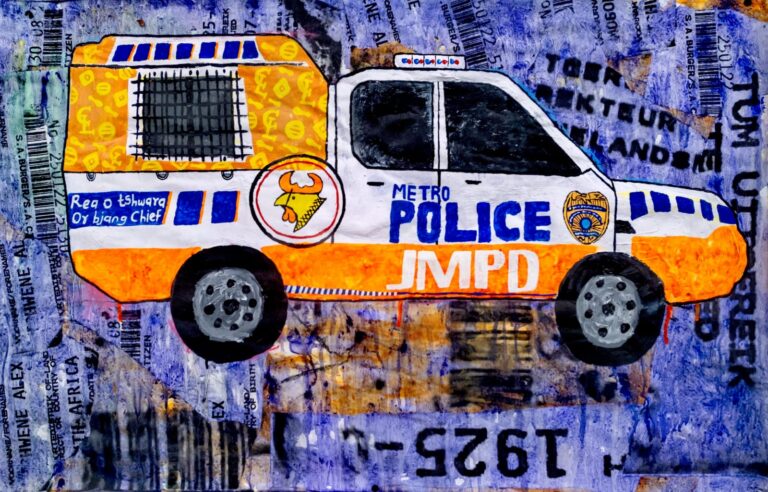
“Tsa sefaleng le meraloko ye mengwe”, loosely translated from Sepedi, means “A theatre stage piece and other plays” (Ramotoana). Richard Mokgomme’s third solo exhibition is composed as a theatre play, narrating the story of politics in South Africa after 1994. Ramotoana confronts the successes and failures of the political leaders post the implementation of democracy. The works in this exhibition explore the current affairs impacting South Africa: COVID-19, load shedding, the distressing unemployment rate, and the ever-declining standard of education. “If you produce political artwork, there is an assumption that your work will not sell. I want to break this notion. I want to create awareness among the youth that we have a responsibility to share our voice in the political space” (Ramotoana).
"If you produce political artwork, there is an assumption that your work will not sell. I want to break this notion. I want to create an awareness among the youth that we have a responsibility to share our voice in the political space"
Art by RR Mokgomme
Ramotoana references his late father’s green ID book in many of his artworks. The old South African coat of arms is observed in relation to the new coat of arms; a reminder of how the political landscape has changed. He also uses the ID book to critically examine justice, democracy, and the South African constitution. The body of work displayed in this exhibition encourages us to engage and unpack the controversial issues of land ownership, migration, and cultural identities. Ramotoana has developed a narrative through the mediums of collage, linocut, monotype, and lithograph painting. To create the sculptures, he has used a collection of found objects and the bones of animals who died after eating discarded plastic and disposable nappies. “The exhibition doesn’t serve as a conclusion but rather as a means to expose these political and economic matters so that we can discuss them openly” (Ramotoana). The meaning of the work is deeply submerged, but Ramotoana’s intention is to shock viewers through many layered elements.
Art by RR Mokgomme
Ramotoana Richard Mokgomme was born and raised in Indermark, a village in the Limpopo province of South Africa. At 5 years old, he was introduced to art, and his interest grew when he was enrolled at Kgobokanang Primary School in 1996. His artistic talents were nurtured by his former art teacher and mentor, Mr. Simon Moshapo. In 2012, Ramotoana enrolled in printmaking lessons at the Johannesburg Art Gallery. The course fueled his creativity, and he decided to pursue a professional career in art. In 2016, he enrolled in a 3-year printmaking course at the Johannesburg Artist Proof Studio. He graduated with excellence and obtained a distinction in concept development. As the top student, he also set a record by selling out of 7 joint plates that formed a body of work for the 3rd year graduation exhibition. Ramotoana’s father passed away when he was 5 years old.
Art by RR Mokgomme
"The exhibition doesn't serve as a conclusion but rather as a means to expose these political and economic matters so that we can discuss them openly"
As an adult he longed to know his father and searched for photographs of him, but he realised that the one and only photograph his father owned was his ID photo in his South African green ID book. His father’s ID book has become the inspiration for many of Ramotoana’s artworks, and it has drawn his attention to South Africa’s political and economic history. Ramotoana’s work focuses on reconstruction and tracing different identities to find new meanings. This allows him to explore concepts with non-figurative and figurative elements in his work. Viewers of his artwork are immersed in many different layers of meaning. Ramotoana is the founder and director of Mokgomme in the Arts Studio (Pty) Ltd and the Rich-Art clothing apparel brand. His studio is based at the OOVOOKOO Creative Community in Selby, Johannesburg, where Ramotoana is currently practicing as a full-time visual artist, specialising in painting, printmaking and sculpture.